
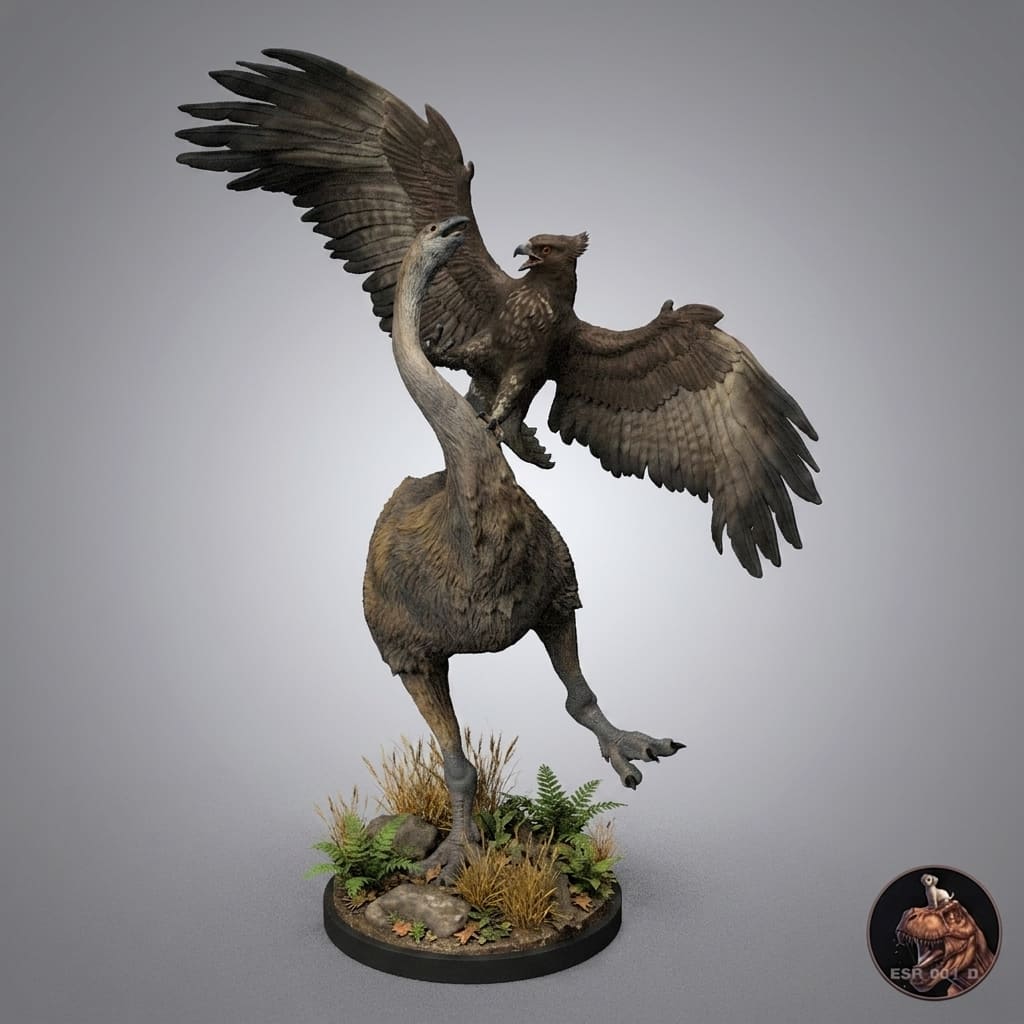
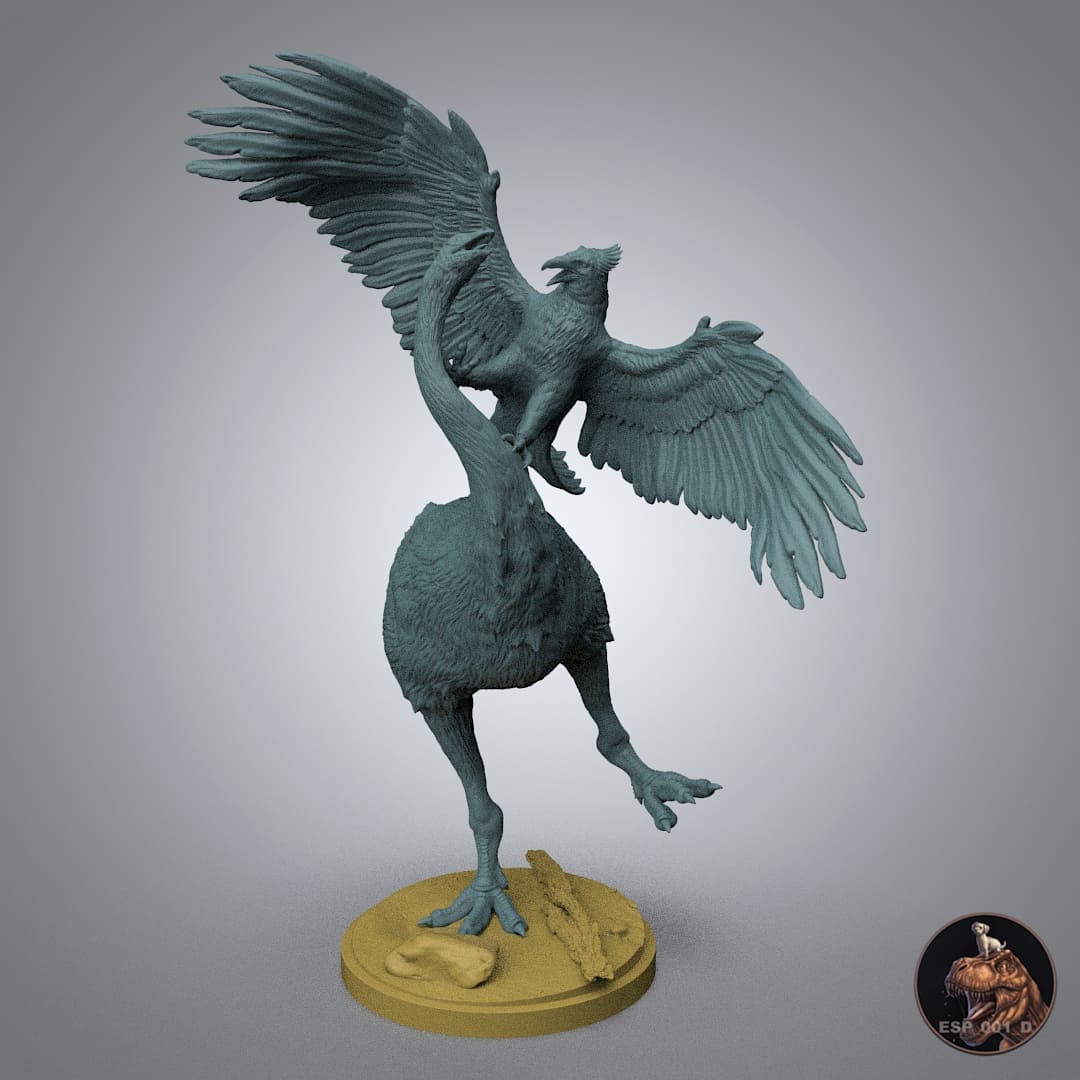
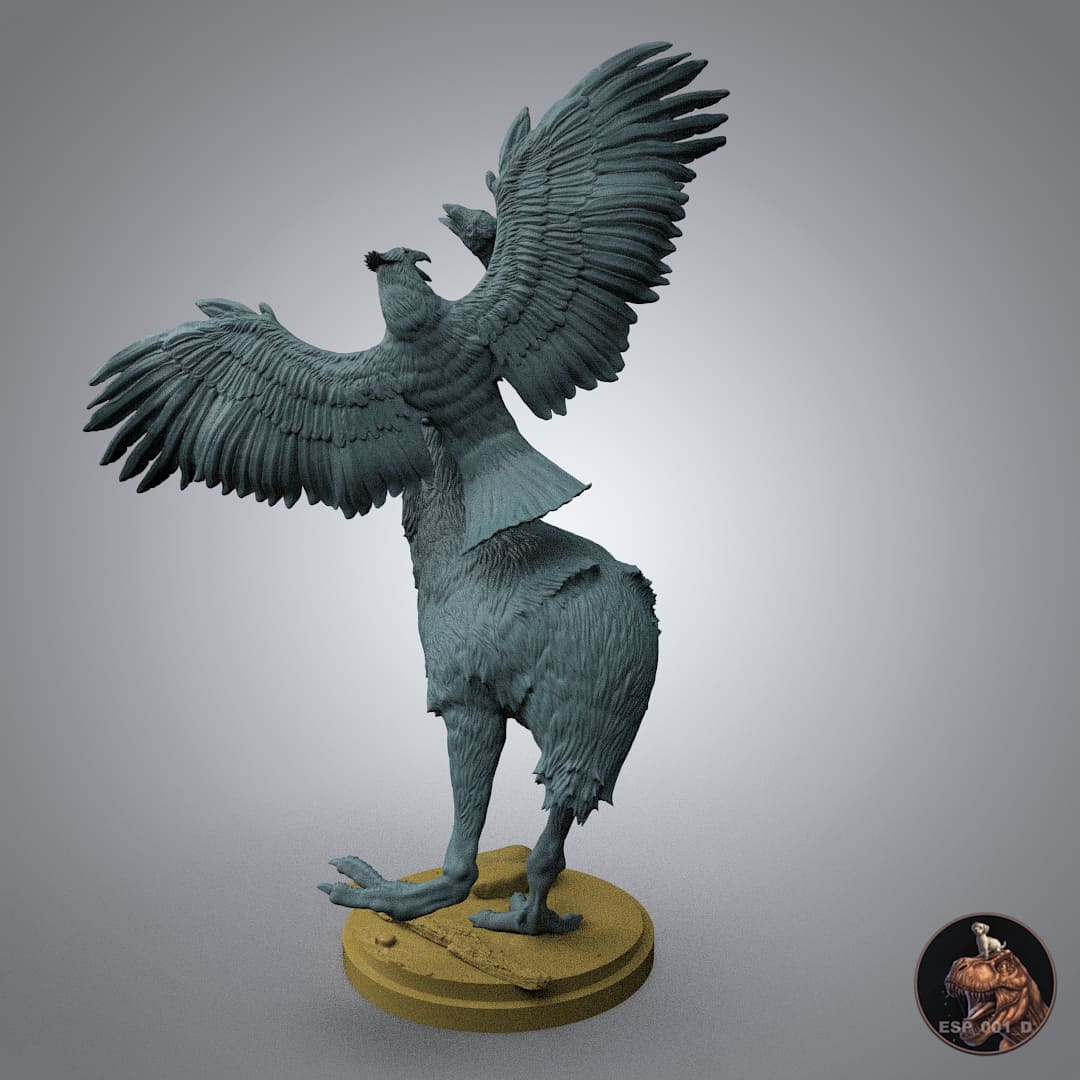
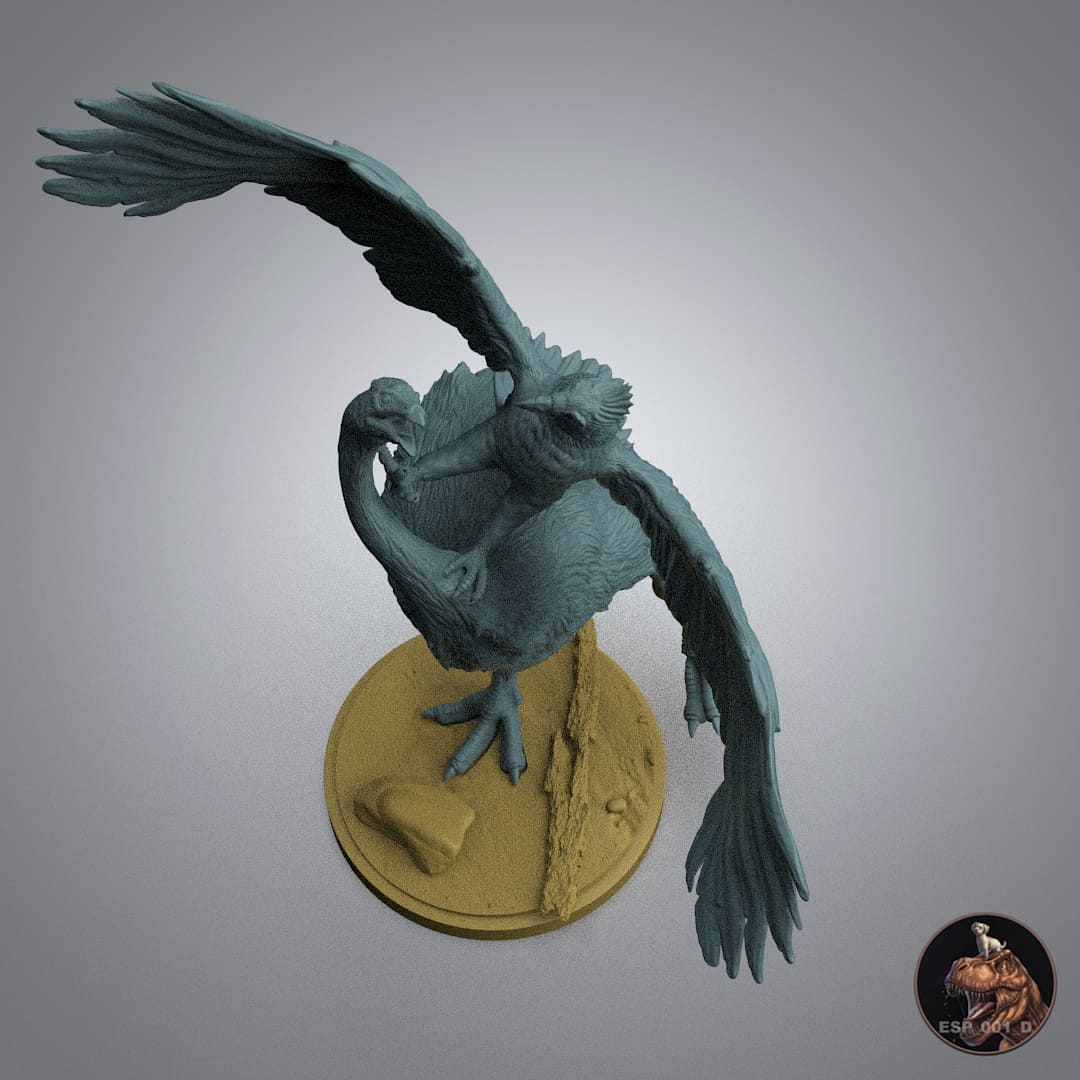
Hieraaetus moorei / Moa
Do you want another scale?
Contact us and we will make it possible!
How will you receive your replica?
In the unprimed and primed variants, you will receive the complete replicas except for the large models, where you will receive an assembly kit.
In the hand-painted variant, the replicas will be delivered complete.
How does the painting service work?
We created a private chat for you where you will have direct communication with our painter , being able to choose your preferred color schemes and follow the hand painting process closely.
Pairs well with
Hieraaetus moorei / Moa
If you have any questions, you are always welcome to contact us. We'll get back to you as soon as possible, within 24 hours on weekdays.
Shipping Information
Visit our shipping policy page to find all the information.
Customer Support
Give us a few details and we’ll offer the best solution. Connect by chat or email.
We are available 24/7.
FAQ’s
Visit our FAQ's page to find answers to common questions.
Contact Us
We'd love to hear from you. We are here to help. Visit our contact page to send us a message.
Product details
Haast’s Eagle and Moas
Detailed Description
The relationship between Haast’s Eagle and the moas represents one of the most spectacular examples of predator-prey interaction in recent island ecosystems. Both groups evolved exclusively in New Zealand and disappeared shortly after the arrival of Polynesian humans during the 13th and 14th centuries.
For thousands of years, moas occupied the role of large terrestrial herbivores in New Zealand, while Haast’s Eagle evolved as their main natural predator, eventually becoming the largest known bird of prey in recent history.
Haast’s Eagle
Hieraaetus moorei
Classification
Haast’s Eagle, currently classified as Hieraaetus moorei, belonged to the family Accipitridae, the group that includes true eagles, hawks, kites and other diurnal birds of prey.
For a long time, it was placed in the genus Harpagornis. However, genetic analyses showed that it was closely related to much smaller eagles of the genus Hieraaetus. This indicates that it evolved gigantism from a relatively small Australian ancestor within a remarkably short evolutionary period.
Dimensions
It was the largest known eagle:
- Body length: 1.1–1.4 m
- Wingspan: 2.5–3 m
- Estimated female weight: 10–18 kg
- Estimated male weight: 9–12 kg
Females were considerably larger than males, showing extreme sexual dimorphism even by the standards of birds of prey.
Although some modern eagles may reach similar wingspans, none combine such high body mass with such powerful musculature and robust limbs.
Anatomy
Haast’s Eagle possessed an anatomy highly specialized for hunting large terrestrial prey. Its most distinctive features included:
- Exceptionally robust legs.
- Very thick toes.
- Enormous talons, up to 7–9 cm long.
- Massive skull.
- Deeply curved beak.
- Powerful hindlimb musculature.
The strength of its legs has been compared to that of large predatory cats. Biomechanical estimates suggest that it may have exerted gripping forces greater than those observed in any modern eagle.
Hunting Strategy
Haast’s Eagle probably behaved as an ambush predator. Its attacks may have been launched from:
- Open woodland.
- Forest margins.
- Mountainous areas.
- Transitional zones between dense vegetation and open ground.
Its hunting strategy would have consisted of descending at high speed onto the prey, striking it violently and driving its talons into vulnerable areas such as the pelvis, back, neck or head. It would then have used its beak to inflict lethal wounds.
Some studies have suggested that it may have reached impact speeds exceeding 80 km/h, making its attacks extremely violent and highly effective.
The Moas
Order Dinornithiformes
Classification
Moas were giant flightless birds endemic to New Zealand. They belonged to the order Dinornithiformes and had no direct equivalent in modern fauna.
Several species are known from different genera, including:
- Dinornis robustus
- Dinornis novaezealandiae
- Pachyornis elephantopus
- Euryapteryx curtus
Size
The largest species reached exceptional dimensions.
The South Island Giant Moa (Dinornis robustus) could reach:
- Maximum height with the neck extended: 3.5–3.7 m
- Estimated weight: 200–250 kg
The North Island Giant Moa (Dinornis novaezealandiae) could reach:
- Height: up to 3 m
- Estimated weight: 150–200 kg
In several species, females were significantly larger than males, showing marked sexual dimorphism.
Anatomy
Moas displayed a highly specialized morphology for terrestrial life. Their main anatomical features included:
- Complete absence of external wings.
- Long, flexible neck.
- Very robust legs.
- Bulky body.
- Relatively small skull.
- Beak adapted for herbivorous feeding.
Moas are the only known birds to have completely lost any visible external wing structures, distinguishing them even from other flightless birds such as ostriches, emus or kiwis.
Feeding
They were specialized herbivores and occupied different ecological niches depending on the species.
Their diet included:
- Leaves.
- Shoots.
- Fruits.
- Ferns.
- Tender branches.
- Low and shrubby vegetation.
Different moa species partitioned the available resources according to feeding height, vegetation type and occupied habitat.
Predator-Prey Relationship
The evolutionary interaction between Haast’s Eagle and the moas produced one of the most unusual ecological systems on the planet.
Haast’s Eagle was virtually the only natural predator capable of regularly killing large moas. Analyses of its talons, skull, limbs and biomechanics suggest that it could take down:
- Juveniles with relative ease.
- Large subadults.
- Adults of medium-sized species.
- Possibly weakened or vulnerable individuals of larger species.
In the case of the largest Dinornis, the eagle likely targeted young, sick or weakened individuals, or carried out highly precise attacks on vulnerable areas such as the neck and head.
The predatory pressure exerted by Haast’s Eagle may have influenced vigilance behaviour, grouping patterns and habitat use in some moa populations.
Extinction
The arrival of the first Māori people in New Zealand, around AD 1280, caused a rapid transformation of the island ecosystem.
Moas were intensively hunted for:
- Their large amount of meat.
- Their large eggs.
- Their bones, which were used as raw material for tools and objects.
Within only a few centuries, all moa species disappeared.
Once its main food source became extinct, Haast’s Eagle also disappeared shortly afterwards, probably during the 15th century.
Scientific Importance
The ecological system formed by Hieraaetus moorei and the moas represents one of the best recent examples of:
- Island gigantism.
- Rapid evolution.
- Predator-prey specialization.
- Adaptation to isolated ecosystems.
- The vulnerability of island faunas to human arrival.
The combination of a bird of prey weighing up to 18 kg hunting flightless birds of more than 200 kg has no modern equivalent. For this reason, the relationship between Haast’s Eagle and the moas represents one of the most extraordinary episodes in recent evolutionary history.
Approximate Diorama Measurements:
Scale 1:20 (Complete)
Length 92 mm
Height 150 mm
Width 95 mm
Information about aftershocks
Collector's item ; Hyper-realistic replica, highly detailed and with a high degree of scientific precision.
Made to scale, prototyped in resin and with a scenic base in most of the models offered. If you like miniatures, both for collecting and for painting, we offer you a wide variety of scale replicas; All of them related to dinosaurs, extinct prehistoric fauna and current fauna.
So if you love dinosaurs and animals as much as we do, this is your favorite store to collect and paint them :)
We are authorized distributors of all the replicas and figures we offer. We use 3D printers with 8K - 14K resolution, and high-quality resins with additives to improve hardness and flexibility, thus offering replicas of impeccable quality.
Different scales will be used to make the replicas (depending on the size of the species), although we are open to making other suggested scales upon request as long as they fit in our printing trays, for which you will have to contact us via email and request the required size.
Replicas are supplied with the option of airbrush priming in dark grey. If you require another colour, please let us know which one you prefer in the box with special instructions for the seller. Without priming, we do not guarantee that the resin will accept paint.
We also offer the option of choosing a professionally painted replica, which is agreed upon throughout its development with the painter, through a private chat available.
Complete replica (one piece): We supply complete replicas in those models that are small, and models that are medium, large or not very bulky, will have the prerogative of being presented as a complete replica or assembly kit as the case may be.
Complete replicas will be supplied separately from their base.
Replica assembly kit: We supply replicas whose models are large, very large or bulky, only with this option.
The indicated replicas (generally composed of base, head, body and tail) will come prepared for the subsequent assembly that will be required by the client, by sanding, putty, adhesive or technique chosen by the client.
All replicas are thoroughly inspected before shipping and will be carefully packaged to prevent damage during transport.
Information about the models
The poses of the models aim to represent each character in the most scientifically viable way, thus revealing the life and customs of prehistoric and modern fauna.
Each character has its own personality and develops in different life scenarios; birth, adolescence and play, hunting, feeding, fighting, courtship, death and many other scenes from their daily life, always from the creative perspective of their designers.
Handmade
All orders are individually prepared on the cutter for subsequent prototyping, obtaining a resin part that will require post-processing by manual and ultrasonic cleaning, support removal, ultraviolet curing, labeling and packaging.
We are authorized distributors
We offer both our own physical replicas and those that have been modeled by many of the best 3D designers, in order to offer you the greatest possible variety.
Frequently Asked Questions
If you have any questions about products, orders or shipping, please read our FAQ page to learn more.