Kosmoceratops
Do you want another scale?
Contact us and we will make it possible!
How will you receive your replica?
In the unprimed and primed variants, you will receive the complete replicas except for the large models, where you will receive an assembly kit.
In the hand-painted variant, the replicas will be delivered complete.
How does the painting service work?
We created a private chat for you where you will have direct communication with our painter , being able to choose your preferred color schemes and follow the hand painting process closely.
Pairs well with
Kosmoceratops
If you have any questions, you are always welcome to contact us. We'll get back to you as soon as possible, within 24 hours on weekdays.
Shipping Information
Visit our shipping policy page to find all the information.
Customer Support
Give us a few details and we’ll offer the best solution. Connect by chat or email.
We are available 24/7.
FAQ’s
Visit our FAQ's page to find answers to common questions.
Contact Us
We'd love to hear from you. We are here to help. Visit our contact page to send us a message.
Product details
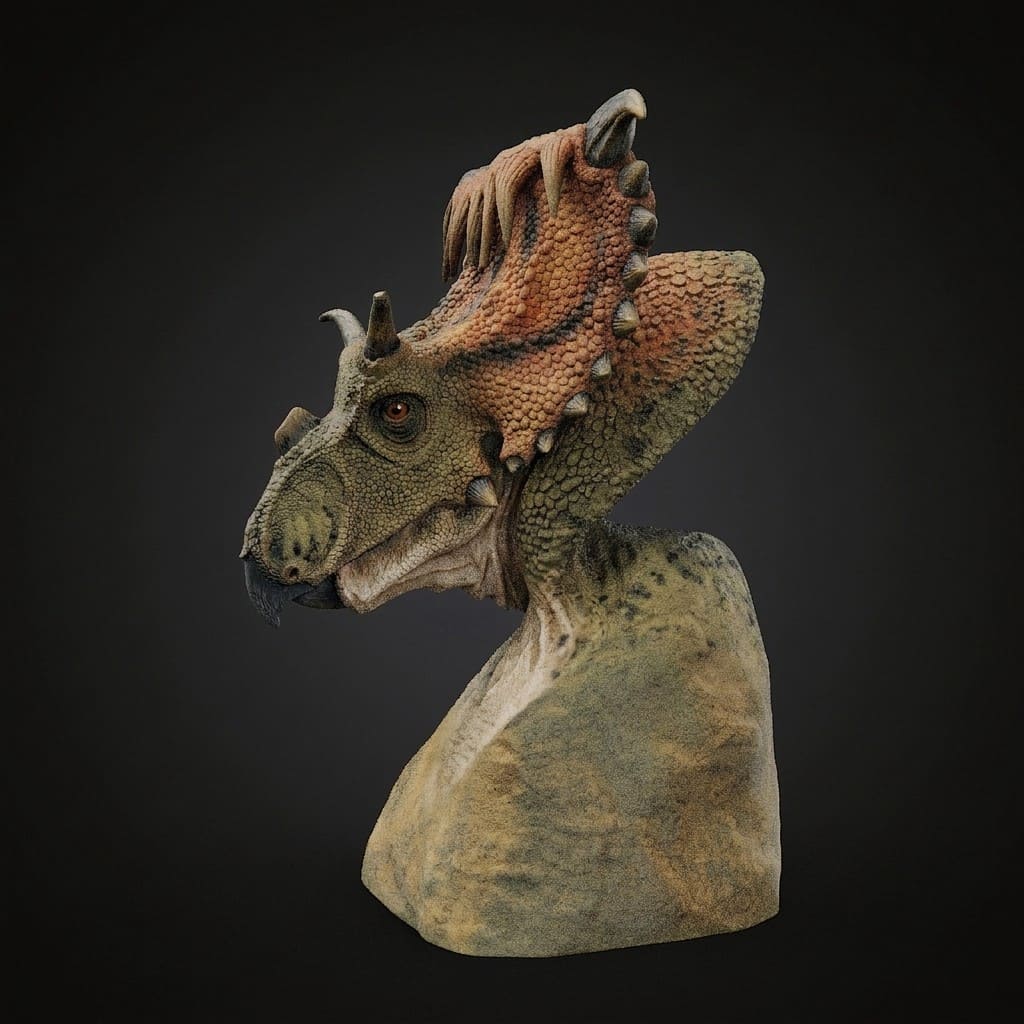
Kosmoceratops richardsoni was a chasmosaurine ceratopsid dinosaur from the Late Cretaceous of North America, known from remains recovered from the Kaiparowits Formation in Grand Staircase–Escalante National Monument, Utah, United States. It lived during the late Campanian, approximately 76–75 million years ago, in the southern part of Laramidia. It was formally described in 2010 and stands out as one of the ceratopsids with the most complex cranial ornamentation known. Its name means approximately “ornamented horned face”, a direct reference to the extraordinary combination of horns and projections on its skull.
Taxonomically, Kosmoceratops richardsoni belongs to Ceratopsidae and, within this family, to Chasmosaurinae, the group of ceratopsids generally characterised by large frills and well-developed supraorbital horns. However, Kosmoceratops differs markedly from the classic pattern seen in forms such as Triceratops or Chasmosaurus because of the remarkable diversity and arrangement of its cranial ornamentation. Its anatomy made an important contribution to the debate surrounding dinosaur provincialism in Laramidia, as the faunas of southern Utah show significant differences from those of northern Montana and Alberta.
From a morphometric perspective, Kosmoceratops was a medium-sized ceratopsid. Common estimates place it at approximately 4.5–5 metres in body length, with a mass of around 1.5–2 tonnes, although these figures should be regarded as approximate. Its body was quadrupedal, compact and robust, with strong limbs, a deep torso, a relatively short tail and a powerful neck capable of supporting a heavily ornamented skull.
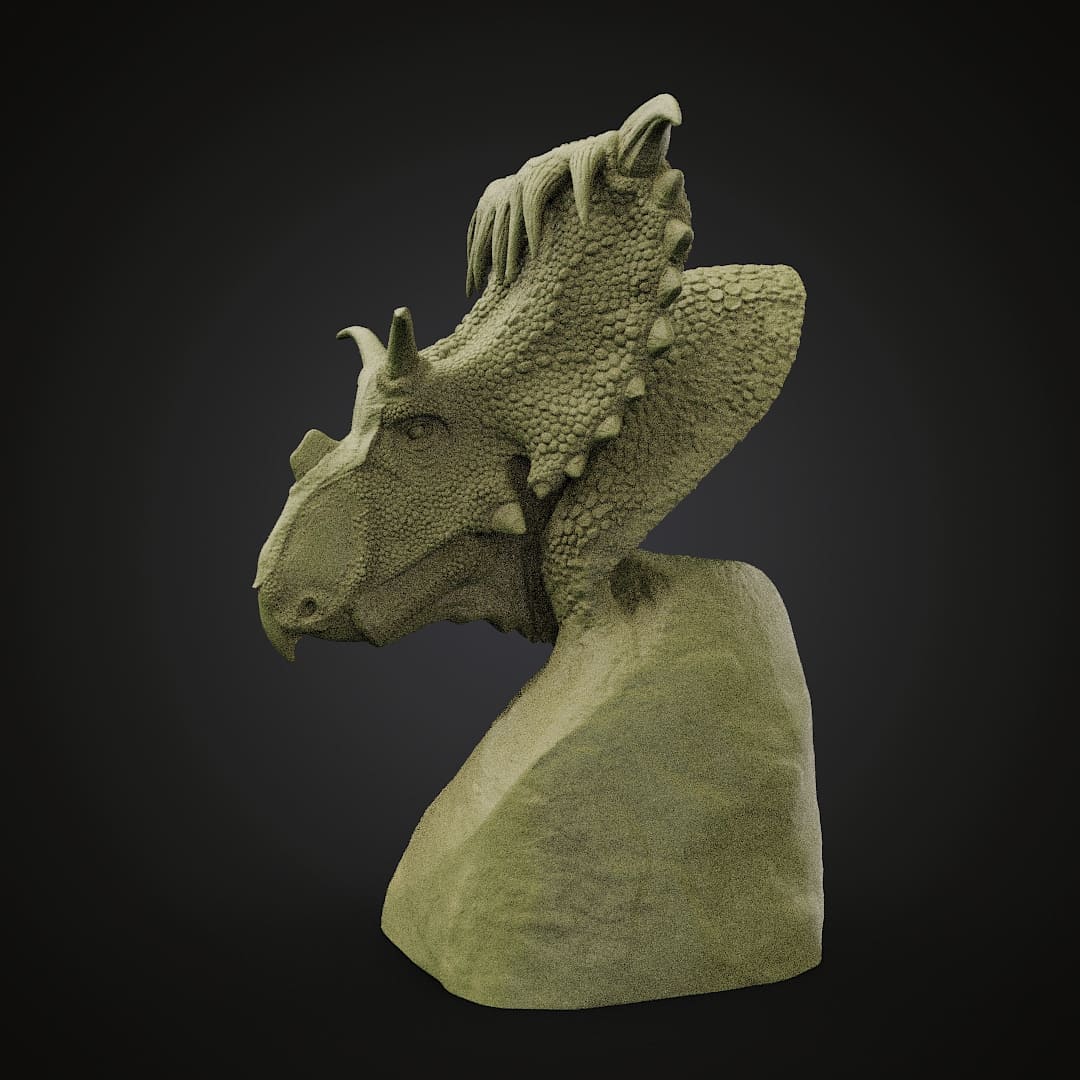
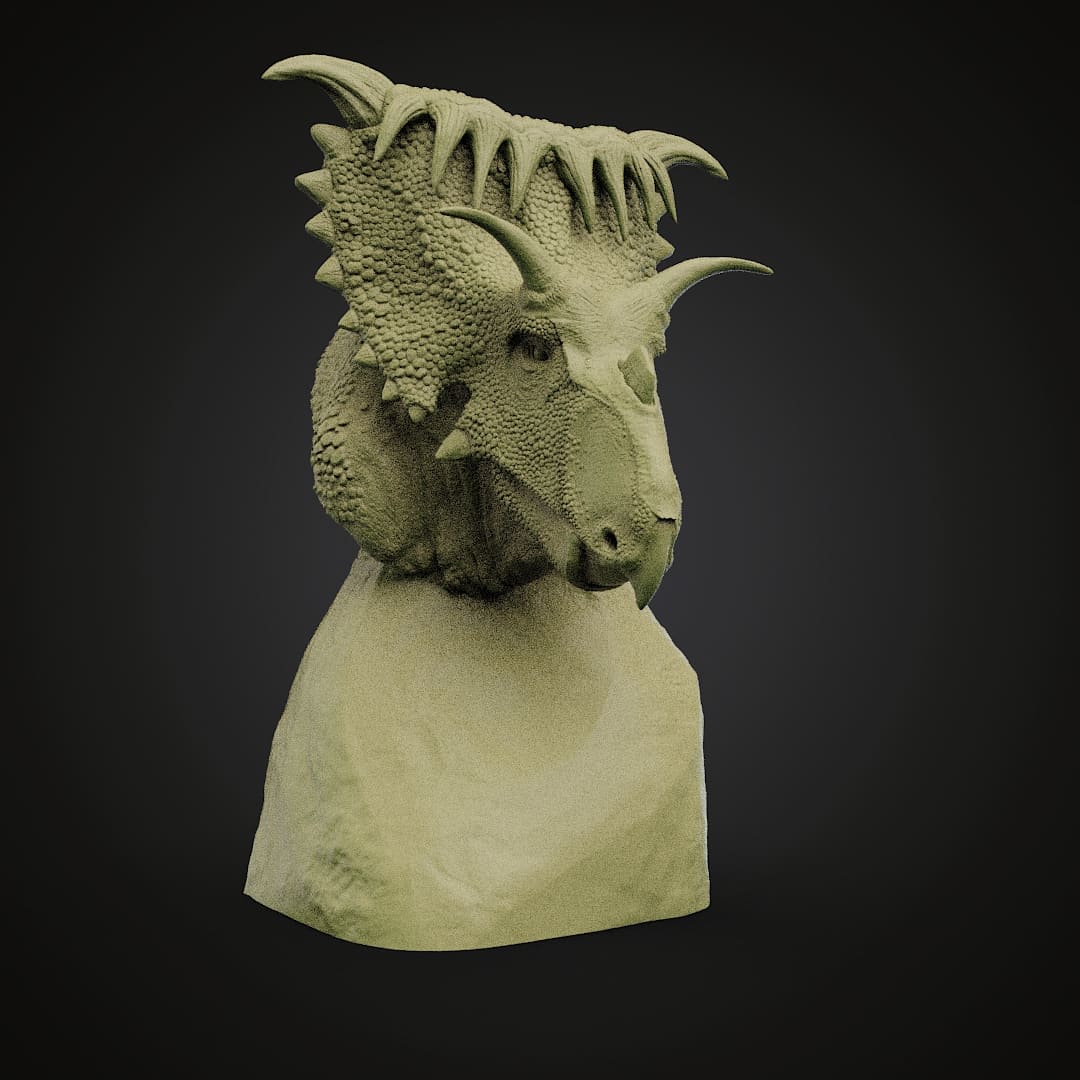
The skull is its most spectacular feature. Kosmoceratops possessed a small nasal horn, large supraorbital horns directed laterally and downward, and a relatively short but extraordinarily ornamented frill. Several curved epiparietals were arranged along the posterior margin of the frill, some projecting forward and downward. Altogether, the animal possessed around fifteen horn-like or horn-shaped structures on the skull, one of the highest numbers known among dinosaurs.
This complex ornamentation probably served mainly visual and social functions. The arrangement of the horns does not appear especially well suited to simple frontal defence, so many of these structures have been proposed to play roles in individual recognition, competition between individuals and sexual selection. The frill may also have acted as a display surface, possibly enhanced in life by contrasting colours or keratinised tissues that would have increased its visual impact even further.
The anterior keratinous beak and dental batteries allowed Kosmoceratops to crop and process tough vegetation. Like other ceratopsids, it possessed teeth arranged in columns with continuous replacement, forming efficient cutting surfaces. Its diet probably included ferns, angiosperms, shoots, branches, conifer foliage and other plant resources available in the humid and subtropical ecosystems of the Kaiparowits Formation.
Its quadrupedal posture was supported by robust forelimbs and powerful hind limbs. The weight of the large skull and frill required highly developed neck musculature. Rather than being adapted for cursorial locomotion, Kosmoceratops was built for stable and powerful movement, with a low centre of gravity and a body capable of supporting both the weight of the skull and possible physical interactions between individuals.
Kosmoceratops richardsoni inhabited ecosystems composed of floodplains, river channels, forests and humid environments near the western coast of the Western Interior Seaway. The Kaiparowits Formation records an extraordinarily diverse fauna including other ceratopsids, hadrosaurids, ankylosaurs, small theropods and large tyrannosaurids. Within this environment, Kosmoceratops occupied the role of a medium- to large-sized herbivore and probably represented an important component of the biomass of southern Laramidian ecosystems.
One of the most interesting aspects of Kosmoceratops is its regional coexistence with other ceratopsids of very different cranial anatomy, such as Utahceratops. This diversity has been used to support the hypothesis that dinosaur populations in Laramidia during the Campanian may have been relatively differentiated between northern and southern regions, possibly due to geographical, climatic or ecological barriers. Although the precise degree of provincialism remains debated, Kosmoceratops is one of the key species in this discussion.
Approximate Replica Dimensions
- Medium: 65 mm high
- Large: 106 mm high
Information about aftershocks
Collector's item ; Hyper-realistic replica, highly detailed and with a high degree of scientific precision.
Made to scale, prototyped in resin and with a scenic base in most of the models offered. If you like miniatures, both for collecting and for painting, we offer you a wide variety of scale replicas; All of them related to dinosaurs, extinct prehistoric fauna and current fauna.
So if you love dinosaurs and animals as much as we do, this is your favorite store to collect and paint them :)
We are authorized distributors of all the replicas and figures we offer. We use 3D printers with 8K - 14K resolution, and high-quality resins with additives to improve hardness and flexibility, thus offering replicas of impeccable quality.
Different scales will be used to make the replicas (depending on the size of the species), although we are open to making other suggested scales upon request as long as they fit in our printing trays, for which you will have to contact us via email and request the required size.
Replicas are supplied with the option of airbrush priming in dark grey. If you require another colour, please let us know which one you prefer in the box with special instructions for the seller. Without priming, we do not guarantee that the resin will accept paint.
We also offer the option of choosing a professionally painted replica, which is agreed upon throughout its development with the painter, through a private chat available.
Complete replica (one piece): We supply complete replicas in those models that are small, and models that are medium, large or not very bulky, will have the prerogative of being presented as a complete replica or assembly kit as the case may be.
Complete replicas will be supplied separately from their base.
Replica assembly kit: We supply replicas whose models are large, very large or bulky, only with this option.
The indicated replicas (generally composed of base, head, body and tail) will come prepared for the subsequent assembly that will be required by the client, by sanding, putty, adhesive or technique chosen by the client.
All replicas are thoroughly inspected before shipping and will be carefully packaged to prevent damage during transport.
Information about the models
The poses of the models aim to represent each character in the most scientifically viable way, thus revealing the life and customs of prehistoric and modern fauna.
Each character has its own personality and develops in different life scenarios; birth, adolescence and play, hunting, feeding, fighting, courtship, death and many other scenes from their daily life, always from the creative perspective of their designers.
Handmade
All orders are individually prepared on the cutter for subsequent prototyping, obtaining a resin part that will require post-processing by manual and ultrasonic cleaning, support removal, ultraviolet curing, labeling and packaging.
We are authorized distributors
We offer both our own physical replicas and those that have been modeled by many of the best 3D designers, in order to offer you the greatest possible variety.
Frequently Asked Questions
If you have any questions about products, orders or shipping, please read our FAQ page to learn more.